Abdul Ghafur Brechna (1907–1974)


Abdul Ghafur Brechna – A Pioneer of Afghan Art and Culture

Abdul Ghafur Brechna was one of the most important Afghan artists of the 20th century—and the first ever to fuse in his work European influences (Impressionism, Expressionism) and the traditional “folk art” of his country. As a painter, composer, stage director, playwright, and poet, he had a major influence on the development and revival of the arts and cultural life of Afghanistan.

Early Life and Education

Brechna was born in Kabul on April 10, 1907. After attending the Habibia School in Kabul up to the age of fourteen, he was among the group of youngsters sent to Germany by King Amanullah in 1921 to study medicine or engineering.

Brechna, however, wanted to become an artist and studied painting and lithography under Max Liebermann, among others, at the Academy of Fine Arts in Berlin and Munich, as well as typography in Leipzig and Barmen.

The European cultural scene, particularly Berlin in the “Golden 20s”, inspired in him a passionate interest in European classical music, dramatic arts, and literature.

Brechna also met and married Marguerite Neufeind (1907–1994) in Germany, and their first child Abdul Habib was born there.

Return to Afghanistan

Brechna intended to return to Afghanistan with his wife and son in 1929, but they arrived in Kabul only in 1930, after traveling for a year through Russia, Uzbekistan (Bukhara), and northern Afghanistan.

He endeavored to transpose the impressions and skills he had gained in Europe to the archaic traditions of Afghanistan. He hoped to revitalize Afghan arts and culture without altering their unique essence. His art was never intended to be elitist but rather to be understood and enjoyed by all.

Teaching and Artistic Work

From 1930 to 1939, as director of the Kabul School of Arts, he fostered a new understanding of the visual arts. Until then, working with watercolors and pastels or from the human model had been unknown in Afghanistan.

In his own works of Afghan Impressionism—portraits, street scenes, cityscapes, and landscapes—he tried to impart his insights into the colorful character, the spartan conditions, the traditions, and the soul of his people.

Among his students were Prof. Ghaussuddin, Prof. Khair Mohammad, Hafizullah, Abdurrab, to name but a few.

Brechna also portrayed famous personalities in Afghan history (poets, philosophers, and rulers), drawing on old descriptions as well as his own imagination. These images were featured in Afghan schoolbooks, after being approved by a group of historians.

Exhibitions

From 1940 to 1972, Brechna’s paintings were exhibited in various towns in Afghanistan, several times in Kabul, including at the Goethe Institute (1959, 1969) and the Rotary Club (1971).

He also had exhibitions in:

  • India (Delhi, 1954, 1974)
  • USA (New York, 1957)
  • Egypt (Cairo, 1956)
  • Russia (Moscow, 1965, 1973)
  • Iran (Tehran, 1953, 1966)
  • China (Beijing, 1967)
  • Bulgaria (Sofia, 1967)
  • France (Cannes, 1971)
  • Uzbekistan (Dushanbe, 1972)

These exhibitions took place at the official invitation of the respective states.

Media, Music, and Cultural Promotion

From 1938 to 1943, as managing director of Afghanistan’s state-owned printing and publishing house, Brechna was responsible for the editing and layout of national newspapers, magazines, and yearbooks. He introduced color-printing techniques and restructured content and layout.

When German teachers had to leave during WWII, Brechna and other Germany-educated Afghans volunteered to take their place. He also took on the unpaid role of school director.

In 1940, he and his wife Marguerite Brechna—who also taught as director of a girls’ school—together devised and illustrated a textbook for German-speaking schools in Afghanistan.

In the 1930s, Brechna traveled extensively to study traditional lifestyles and collect folk music. As musical director and later director general of Radio Afghanistan (1943–1953), he promoted this heritage by inviting musicians from all provinces to perform.

A radio orchestra combining local and European instruments was formed, credited with professionalizing Afghan folk music. Radio Kabul broadcast these styles nationwide and to Pakistan, Iran, and Uzbekistan.

In 1940, he founded the first School of Music in Afghanistan.

As director general, he supported young musicians and singers, including Ustad Mermon Parwin, the first Afghan woman to sing in a public broadcast and to receive the title “Ustad”.

Brechna was committed to women’s rights and social inclusion, working with musicians from Kharabat, a poor musicians’ neighborhood.

According to ethnomusicologist John Baily, “Radio Afghanistan was a bastion of modernism, and its institution considerably improved the status of musicians and singers, male and female, professional and amateur.”

Composer and Playwright

Brechna was an accomplished musician and composed countless songs. Many Afghan, Indian, and Persian artists still perform his work. His students included Zaland and Gul Ahmad Shifta.

He composed the Afghan national anthem in 1973.

Notable compositions:

  • “Mudate ke Shod ke tora” (1966–67), featured in an Indian film
  • “Ai Negare man”, performed by Zaland

He also wrote and directed over 20 plays for radio and theater (1940–1953), painting the stage sets himself. His most famous play, “Lala (Uncle) Malang”, premiered in 1947.

Publications

Brechna published prose, essays, drama, comedies, short stories, poetry, and translations.

Selected works:

  • Prose:
    The Miniatures of Behzad, Beaux Arts in Afghanistan, Afghan Festivals, Tales from Afghan History, The Opium Trail, The Wisdom of Mir Weis Khan, The Tunnel, The Shared Child

  • Theater Plays:
    Lala Malang, The Barber, The Musician, and 17 more

  • Translations (German to Afghan):
    The Voyage of the Russian Emissaries to the Court of Emir Sher Ali Khan (1968)
    L. Jaworskij: The Russian Ambassador’s Travels in Afghanistan and Bukhara (1878–1889)

Political Commentary and Cartoons

Through his cartoons in journals, newspapers, and yearbooks, Brechna highlighted Afghanistan’s political and social shortcomings. His character RAJAB KHAN criticized current affairs with acerbic humor and appeared regularly in newspapers until 1972.

Only about 100 clippings of his cartoons in Karavan Newspaper remain in the family’s possession.

Later Years and Legacy

Brechna retired in 1962, officially, but continued to serve as a cultural advisor throughout his life.

In 1968, he was decorated by German President Heinrich Lübke with the Knight Commander’s Cross of the Federal Republic of Germany for his contributions to German-Afghan cultural relations.

He died on January 4, 1974, in Kabul.

His legacy includes:

  • Watercolors, oil paintings, pastel drawings
  • Pyrography on wood, sculptures
  • Essays, art reviews, poetry
  • Compositions, stage and radio dramas and comedies

Family and Preservation of His Work

Brechna and Marguerite had five sons, three of whom died young. The surviving sons were:

  • Abdul Habib Brechna (ca. 1928–2012, Switzerland)
  • Abdullah Breshna (1933–2021, Germany)

They had four grandchildren: Zahra, Habib, Daoud (†2013), and Jussof.

Marguerite Brechna died in 1994 in Karlsruhe, Germany, after over 50 years of service to Afghan education.

In 1980, Abdullah Breshna fled Afghanistan and, with friends’ help, saved most of his father’s legacy. Since then, Brechna’s work has been kept alive through exhibitions, calendars, postcards, and a CD of his music.

In 2021, Abdullah Breshna endowed his father’s works to the nonprofit Breshna Foundation for Culture, under specific terms for their future use and preservation.

Due to decades of upheaval, many of Brechna’s works remain in Afghanistan. Over 30 paintings are on display at the National Art Gallery (Negarestan Meli) in Kabul. Others are held by the National Museum, Radio Afghanistan, the state publishing house, and the Ministry of Culture, though not yet cataloged.

About 200 works are now held by the Breshna Foundation for Culture. Many others are missing or unaccounted for.


This account of the life of A. Gh. Brechna was written by Abdullah Breshna, based on various sources (books, newspapers, magazines) and supplemented with more recent information.


For a comprehensive overview, please refer to pages 47-58 in our detailed report
Ein Banner mit den Worten "STUTTGART AFGHANISTAN" in großen Buchstaben, daneben in arabischer Schrift, zeigt eine Stadtlandschaft mit einem Fernsehturm und einer Minarett-Silhouette.

EXHIBITON AT LINDENMUSEUM-STUTTGART

A DAY HONORING HIS ARTISTIC LEGACY AT THE LINDEN MUSEUM STUTTGART - APRIL 2024
read more


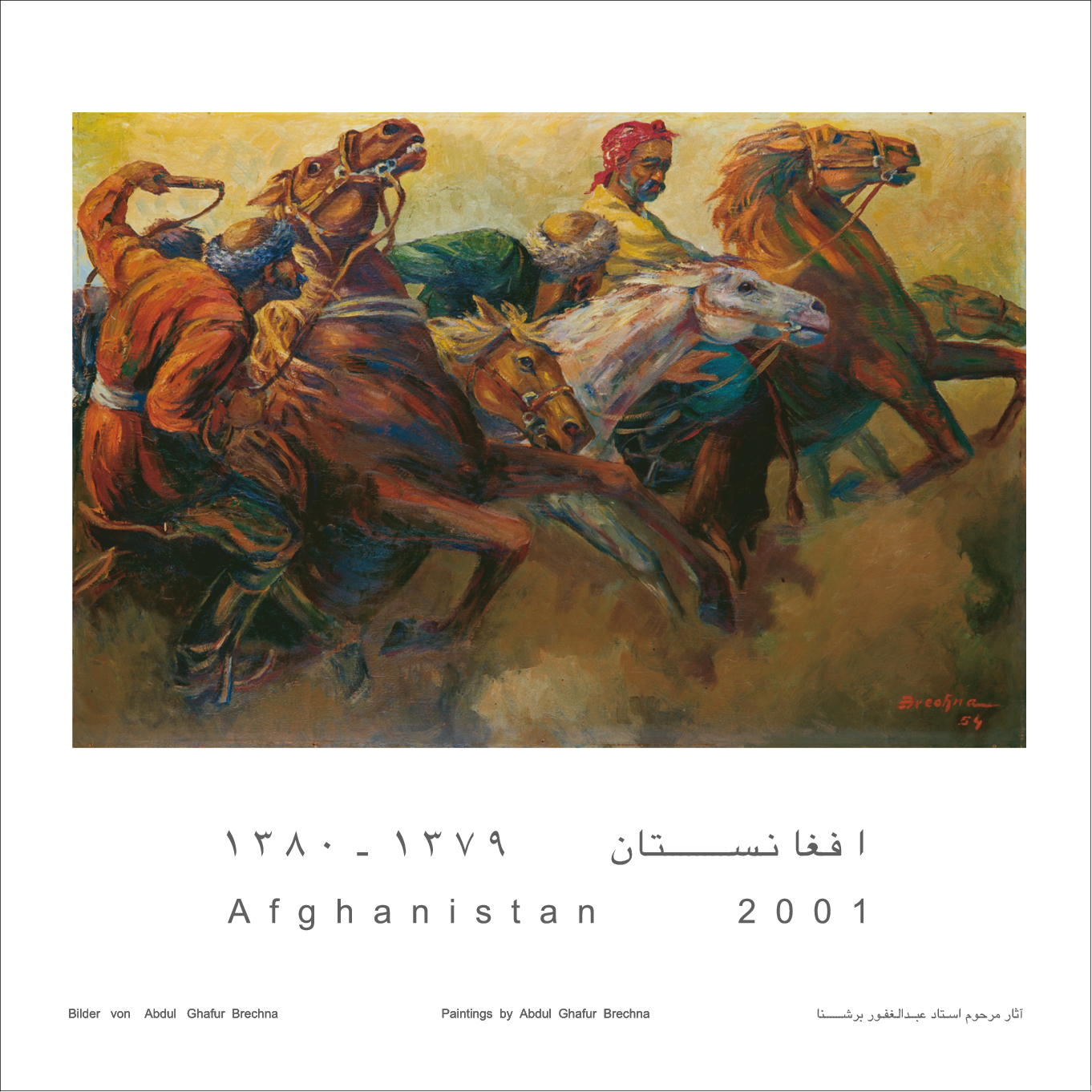
Farbenfrohes Gemälde von Abdul Ghafur Brechna, das mehrere Reiter auf Pferden in einer dynamischen Szene zeigt, mit Text darunter, der auf Afghanistan 2001 hinweist.

CELEBRATING AFGHAN ART AND CULTURE

REMINDING EXHIBITIONS SHOWCASING MASTERPIECES OF ABDUL GHAFUR BRECHNA

read more

Annual Report of the Breshna Foundation for Culture

General Overview of Foundation Setup and Program on Progress and Outlining Future Projects